Thursday, July 2, 2009

Carbon credit traders turn to option contracts

Carbon credit traders turn to option contracts
By Morten Andersen 02/07/2009 10:15
Ref: http://en.cop15.dk/news/view+news?newsid=1648

Uncertain of the outcome of December’s UN climate change conference, investors are getting nervous over their carbon credit portfolios.

A new trend in carbon credit trading has emerged, financial news agency Bloomberg reports: Instead of buying additional carbon credits (or Certified Emission Reductions, CER), investors turn to option contracts.
The contracts – also named “put options” – give investors the right to sell credits at fixed prices.
This strategy will limit the losses, should the parties to the UN Framework Convention on Climate Change agree to scale down or abandon the so-called Clean Development Mechanism (CDM) at December’s conference in Copenhagen.
“Some people are nervous about their portfolios and are seeking insurance to cover their exposure,” Ken Schneider, an options trader at New York-based environmental hedge fund RNK, tells Bloomberg, while stressing that he personally doesn’t believe in the strategy:
“Spending a couple of million euros to protect tens of millions is a no brainer, in my mind.”
The number of credits created under the UN program fell 30 percent last year, and the total amount financed under it dropped 12 percent to 6.5 billion USD, according to the World Bank. The UN credit benchmark has dropped 44 percent from a year ago, down to about 12 euros per ton. The fall in prices can mainly be attributed to global economic recession.

State World Forum - On Green Project

01 Introduction Invocation by Jim Garrison.mp3 -

The Washington Forum will continue to emphasize the urgency of global warming and the fact that each and every one of us must become climate leaders. For the first time in our lives, indeed for the first time in history, all of us must take responsibility for our climate, whether at the individual, community, company, institution, state, or national level. We are all responsible for global warming. We must all share in the leadership required to solve it, for nothing less than the fate of human civilization is at stake. The crisis is that stark, the choice is that clear, the leadership required is that urgent.
If we rise to this challenge, if we take climate leadership, we will generate climate prosperity and climate justicebecause it is precisely our capacity to solve our greatest crisis that affords us our greatest opportunities for growth within the context of sustainability and alignment with natural systems.

Action Plan


The Washington Forum will continue building the global Climate Leadership network charged with thinking through and articulating what exactly needs to be done in order to accomplish by 2020 what our governments are currently negotiating for 2050.
In considering how this can be accomplished, we have partnered with Lester Brown, founder of the Earth Policy Institute and author of the seminal work Plan B 4.0. If there is one person in the world who understands our global predicament from the point of view of its solvability, Lester Brown is that person. Lester knows the complexity and urgency of the escalating effects of global warming and understands the relationship between ecology and economy. In Plan B, he recommends numerous solutions, including reducing our carbon emissions by 80% by 2020, which if implemented would shift the basis of our economies from fossil fuels to alternative energy. Lester is convinced, as many are, that climate change is now endangering human civilization itself and that we must act decisively and immediately to solve the crisis.
We will also be drawing from other seminal thinkers and organizations such as the Presidential Climate Action Project that has done very comprehensive work in suggesting how President Obama can begin to tackle the issues of climate change; the Apollo Alliance that has mapped out powerful long term initiatives that will contribute to the greening of our economies; the work of Friends of the Earth on the carbon tax; Global Urban Development, which has created a worldwide network of cities working on developing green economies; and the Asian Foresight Institute which advises governments, corporations and institutions on climate change, among many others.


We will hear from Rajendra Pachauri, Head of the Intergovernmental Panel on Climate Change; James Hansen, Director of NASA’s Goddard Institute for Space Studies; Bill Becker, Director of the Presidential Climate Action Project; Brent Blackwelder, President of Friends of the Earth; Mary Otto-Chang, Consultant with the UNICEF Regional Office for Latin America and the Caribbean for Children and Climate Change; Richard David Hames, strategic thinker and author; Ervin Lazslo, Founder of the Club of Budapest; Karen O'Brien, Chair of the Global Environmental Change and Human Security at the University of Oslo; Jerome Ringo, Chairman of the Apollo Alliance; Hunter Lovins environmental activist and author; Sandra Postel, Director of the Global Water Project; and Herman Wijffels, Member of the Office of the Executive Director at the World Bank, among others who will be added as we develop the agenda.

A Global Perspective
The 09 Forum will be distinctive in that we will investigate how other crucial domains besides government action, business transformation and reducing carbon emissions will be needed in order to accomplish our goals. To deal effectively with climate change and the collapse of financial systems, our entire societies need transformation. In order to generate the political will for what so urgently needs to be done we must be prepared to change our personal and cultural lives as dramatically as we green our economic and political structures. Only then will we attain the solutions we all seek.
What this requires is for us to embrace a number of big ideas:
• First, we must understand that we are confronted by a planet-wide problem and we are all in the same boat together. There is no us versus them on this one.
• Second, we will need to involve an amazing variety of populations across the world and the full spectrum of every kind of organization in every sector of the economy, governance and civil society in order to succeed.
• Third, we cannot treat anyone or any group in isolation, trying to solve one problem at a time, because we are all linked together as the planet starts to become one world for the first time in history. Planetary integration is our next industrial revolution. This presents us with both a grand opportunity and a tough challenge. All of us -- as individuals, communities, organizations, and governments are, or are becoming, part of one planetary network of systems.
• Fourth, practical success at getting things done will be helped by making strategic and integrated use of all of our technology, all of our leadership, all of our plans, and all of our individual and collective values and actions. Greening our economies therefore requires a complete shift in thinking, values, actions and intentions.

An Integral Approach

To assist us in developing an effective way to organize the information available to us and to integrate the various aspects of our humanity that must be brought together, we will draw upon integral thinking as the organizing framework for the process. Ken Wilber, the leading integral philosopher of our time and founder of Integral Life, has thought through more comprehensively than anyone we know how to organize human knowledge, specifically how our values and actions interact and mutually affect one another. We will be using his integral framework as the operating system for the Forum, as a tool to organize information and develop approaches for understanding how best to proceed. This is an approach that combines facts and values -- what people do in relation to what they believe -- in a profound synthesis that enables holistic thinking and effective decision making and values-based leadership.
In developing an integral perspective, we will draw upon the powerful work in the field of social artistry by Jean Houston, an expert in human capacities, who has trained emerging leaders from all over the world; from Caroline Myss, best selling author, who has explored very deeply how to overcome humanity’s troubling tendency toward denial and habituation to the suffering of others; Monica Sharma, who has worked throughout the global south with the UN, and has a powerful perspective on how values and culture affect human empowerment; and Rob Work, who has spent decades working internationally and from an integral perspective to empower leaders and communities in the art of resilience and creativity.
We will examine the contributions of social psychology, cultural development and personal growth and how they can inform and guide us in developing the leadership qualities and best practices required to succeed in actually accomplishing the tasks at hand. By the end of the Forum, all of us will have a deeper sense of both what needs to be done and what we can personally and collectively do to implement the goals we seek to achieve.

A Rising Tide of Cultural Creativity

In this regard, the Forum will highlight new data on a fundamental shift taking place in global values. The latest research shows that “new progressives” now constitute the largest single voter constituency in the United States and which strongly supports moves toward a green economy. Similar trends can be seen in Europe, Japan and in cities and constituencies throughout the global south. Research conducted by sociologist Paul Ray shows that roughly one third of the public is now “culturally creative” and that over 70% supports decisive action on global warming, among other ecological concerns. The important conclusion from this research is that politicians who are willing to speak to progressive values and take decisive action on global warming can win elections.
Focusing on the relationship between leadership, ecology and economy, using Plan B, along with other suggestions, as the basis of a ten year plan to green our economies, utilizing integral approaches to seeing how we can personally as well as collectively develop a restored moral basis of our lives, all support the central focus of the 09 Forum, which will be on how to galvanize the public support necessary for the kind of political action required.

A Call to Engage

It is remarkable that just as global warming threatens the world and our financial and economic structures are collapsing, endangering our political institutions and our way of life, new social values are emerging along with the appreciation, skills and technologies that can shape a future sustainable and resilient enough to meet the challenges besetting us. The implications of this emerging wave of change are as profound as the threat of global warming is imminent.
We are in a time of enormous transition, when the present is crumbling right from under our feet, but the future is not quite clear enough for us to grasp. What is needed is imagination and a sense of possibility to bridge the gap between present and future.
The State of the World Forum is committed to working with partners worldwide to catalyzing the imagination needed and the collaboration required to both envision and implement the world we must fashion as humanity moves beyond the War on Terror into the next phase of human development. Joining together to make this commitment can generate a veritable renaissance of international solidarity and good will.


Tuesday, June 23, 2009

A warning from Copenhagen


In March the biggest climate conference of the year took place in Copenhagen: 2500 participants from 80 countries, 1400 scientific presentations. Last week, the Synthesis Report of the Copenhagen Congress was handed over to the Danish Prime Minister Rasmussen in Brussels. Denmark will host the decisive round of negotiations on the new climate protection agreement this coming December.

The climate congress was organised by a "star alliance" of research universities: Copenhagen, Yale, Berkeley, Oxford, Cambridge, Tokyo, Beijing - to name a few. The Synthesis Report is the most important update of climate science since the 2007 IPCC report.
So what does it say? Our regular readers will hardly be surprised by the key findings from physical climate science, most of which we have already discussed here. Some aspects of climate change are progressing faster than was expected a few years ago - such as rising sea levels, the increase of heat stored in the ocean and the shrinking Arctic sea ice. "The updated estimates of the future global mean sea level rise are about double the IPCC projections from 2007″, says the new report. And it points out that any warming caused will be virtually irreversible for at least a thousand years - because of the long residence time of CO2 in the atmosphere.

Perhaps more interestingly, the congress also brought together economists and social scientists researching the consequences of climate change and analysing possible solutions. Here, the report emphasizes once again that a warming beyond 2ºC is a dangerous thing:

Temperature rises above 2ºC will be difficult for contemporary societies to cope with, and are likely to cause major societal and environmental disruptions through the rest of the century and beyond.

(Incidentally, by now 124 nations have officially declared their support for the goal of limiting warming to 2ºC or less, including the EU - but unfortunately not yet the US.)

Some media representatives got confused over whether this 2ºC-guardrail can still be met. The report's answer is a clear yes - if rapid and decisive action is taken:

The conclusion from both the IPCC and later analyses is simple - immediate and dramatic emission reductions of all greenhouse gases are needed if the 2ºC guardrail is to be respected.

Cause of the confusion was apparently that the report finds that it is inevitable by now that greenhouse gas concentrations in the atmosphere will overshoot the future stabilization level that would keep us below 2ºC warming. But this overshooting of greenhouse gas concentrations need not lead temperatures to overshoot the 2ºC mark, provided it is only temporary. It is like a pot of water on the stove - assume we set it to a small flame which will make the temperature in the pot gradually rise up to 70ºC and then no further. Currently, the water is at 40ºC. When I turn up the flame for a minute and then back down, this does not mean the water temperature will exceed 70ºC, due to the inertia in the system. So it is with climate - the inertia here is in the heat capacity of the oceans.

From a natural science perspective, nothing stops us from limiting warming to 2ºC. Even from an economic and technological point of view this is entirely feasible, as the report clearly shows. The ball is squarely in the field of politics, where in December in Copenhagen the crucial decisions must be taken. The synthesis report puts it like this: Inaction is inexcusable.

Related links

Press release of PIK about the release of the synthesis report

Copenhagen Climate Congress - with webcasts of the plenary lectures (link on bottom right - my talk is in the opening session part 2, just after IPCC chairman Pachauri)

Nobel Laureate Meeting in London - a high caliber gathering in May that agreed on a remarkable memorandum which calls for immediate policy intervention: "We know what needs to be done. We can not wait until it is too late." The new U.S. Energy Secretary Steven Chu participated over the full three days in the scientific discussions - how many politicians would have done that?

“Climate Change and the achievement of the Millennium Development Goals”

Wind could power the entire world

Jeremy Hance
mongabay.com
June 22, 2009

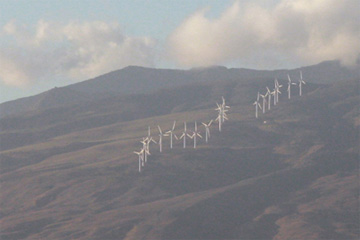
Wind power may be the key to a clean energy revolution: a new study in the Proceedings of the National Academy of Science finds that wind power could provide for the entire world’s current and future energy needs.

To estimate the earth’s capacity for wind power, the researchers first sectioned the globe into areas of approximately 3,300 square kilometers (1,274 square miles) and surveyed local wind speeds every six hours. They imagined 2.5 megawatt turbines crisscrossing the terrestrial globe, excluding “areas classified as forested, areas occupied by permanent snow or ice, areas covered by water, and areas identified as either developed or urban,” according to the paper. They also included the possibility of 3.6 megawatt offshore wind turbines, but restricted them to 50 nautical miles off the coast and to oceans depths less than 200 meters.

Using this criteria the researchers found that wind energy could not only supply all of the world’s energy requirements, but it could provide over forty times the world’s current electrical consumption and over five times the global use of total energy needs.

Turning to the world’s two largest carbon emitters, China and the United States, the researchers found that wind power has the potential to easily supply both nations.


“Large-scale development of wind power in China could allow for close to an 18-fold increase in electricity supply relative to consumption reported for 2005,” the researchers write. “The bulk of this wind power, 89%, could be derived from onshore installations. The potential for wind power in the U.S. is even greater, 23 times larger than current electricity consumption, the bulk of which, 84%, could be supplied onshore.”

Expanding their view to the top ten carbon emitters, the researchers found that Russia, Canada, and the United States (in this order) had the greatest capacity for wind power. However, they note that much of the area available for wind power in Russia and Canada is far from any cities, making their construction costly. In addition, the authors note that the public may oppose wind turbines in particular areas, especially remote, ecologically sensitive regions. Still, they conclude that “despite these limitations, it is clear that wind power could make a significant contribution to the demand for electricity” in most high carbon emitting countries.

Monday, June 22, 2009

With eye on global warming, students analyze campus emissions

Princeton students concerned about global warming are taking a close look at how the University can contribute to solving the problem.
Participants in a student-initiated environmental studies seminar spent the fall semester combing the campus for ideas on how to enhance the University's efforts to mitigate its emissions of carbon dioxide, the major culprit behind global warming. The students worked to develop various scenarios for environmentally friendly strategies, ranging from upgrading to more energy-efficient windows and lights to broader ideas such as expanding the use of geothermal or solar heat around campus.....

http://www.princeton.edu/main/news/archive/S17/09/46G82/index.xml?section=

As I'd read, I think their concerns about global warming is pretty impressive. It started with the idea of how the Princeton University can contribute to solving the problem. It ended up with focusing on developing policies to encourage sustainable use of energy at Princeton, which I believe that it would be a effective beginning of the whole solution. They also create a seminar on greenhouse gas initiatives that the whole process finally came up with the development of policy initiatives for the sustainable use of energy at the University....

EcoFacts: Climate Change in Bangkok

According to a recent report – “Greater Bangkok is home to more than 10 million people or nearly 15 per cent of Thailand’s population, although the registered population is closer to 6 million. The city’s rapid growth as an industrial and urban centre is already placing strains on its environment. Climate change will exacerbate these pressures.”

“Temperatures are expected to rise as a result of global warming. The likely consequences on the city, already prone to flooding and land subsistence, will be severe.”

What could happen to Bangkok as a result of global warming? Find out more in this interesting report by the United Nations Environmental Programme (UNEP)…

http://www.roap.unep.org/BARCC_2009/BARCC_brief.pdf